SECTION 3·HOW WE WORK

Six moments an architect earns their fee.

The right architect does not just perform the inspection. They protect the board or owner across six specific moments — from initial scope through permit and construction closeout.

THE PATH·AT A GLANCE

Six phases. Two decision points.

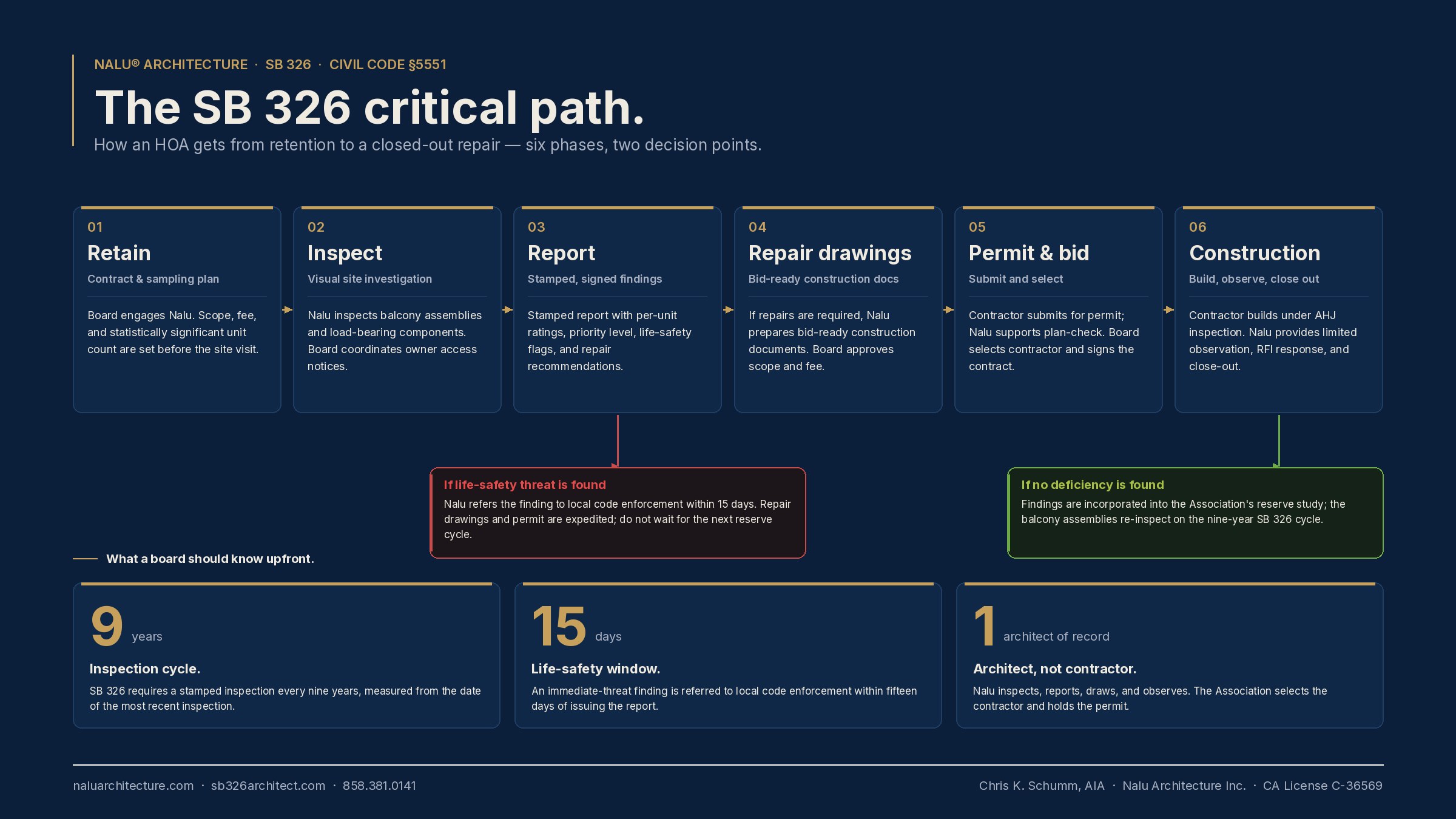
A board never has to guess where a Nalu engagement is heading. The inspection either finds nothing and rolls into the reserve study, or it turns up conditions that route through repair drawings, permit, and construction. If it finds an immediate threat, the fifteen-day clock starts the moment the report is issued.

The SB 326 critical path: six phases from Retain through Construction, with red life-safety detour and green no-deficiency continuation callouts, and three orienting facts — nine-year cycle, fifteen-day life-safety window, and Nalu as architect of record rather than contractor.
  1. Scoping the inspection correctly

    Element counts, sampling method, invasive-testing budget, and the immediate-threat protocol written into the proposal before anyone climbs a ladder. This is where boards get protected from surprise change orders later.

  2. Performing and documenting the inspection

    Written report with photos, element-by-element condition ratings, and the specific SB 326 or SB 721 statutory language required by the reserve study, the association records, and any local code enforcement filing.

  3. Interpreting deficiencies for the board

    Plain-English translation of what the report actually means: what has to be repaired within 120 days, what can be planned into the reserve study cycle, and what the insurance implications are before renewal.

  4. Preparing bid-ready construction documents

    Repair drawings, specifications, and structural coordination that let three qualified contractors bid to the exact same scope — so bids are actually comparable and the board is not picking between apples and oranges.

  5. Running plan check and permit

    Corrections, resubmittals, and coordination with the local building department. This is where amateur permit packages die, projects lose three to six months, and boards get blamed for things they never had visibility into.

  6. Construction administration and closeout

    Site observation during framing and waterproofing, RFI responses, and the closeout package the board files with the completed inspection cycle. This is what makes the next inspection cheaper, faster, and less exposed.

WHAT THIS LOOKS LIKE IN PRACTICE

Two things every proposal should tell you.

Not every SB 326 proposal is comparable. Two things separate a professional scope from a low-ball bid built to disappoint the board six months later:

One: A written invasive-testing budget

The proposal should tell you exactly what invasive testing costs per element and how many elements the architect expects to open up based on the visible sample. Not "TBD." Not "as needed." A real number the board can plan around.

Two: A written immediate-threat protocol

If the inspector finds a life-safety threat, what happens next? Who gets notified, in what order, on what timeline? The 15-day statutory clock does not wait for board meetings. The protocol should be spelled out before the proposal is signed.

These two items are the difference between a proposal that protects the board and a proposal that creates new exposure.
WHAT A NALU SB 326 REPORT LOOKS LIKE

A document the board can act on.

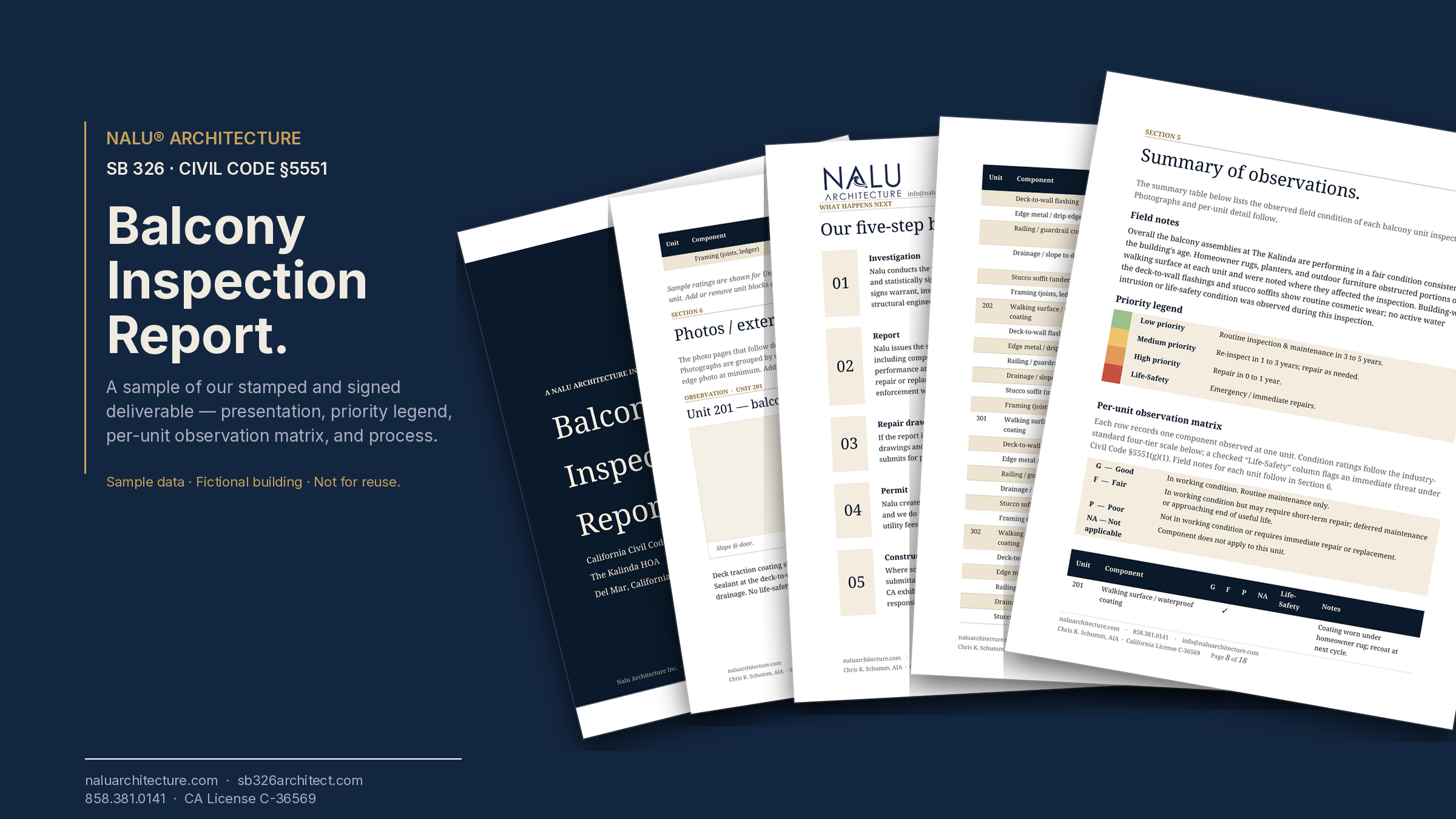
Fanned pages of a sample Nalu SB 326 inspection report showing the cover, photo observation page, process cards, findings matrix, and priority legend
Sample pages. Cover, forensic photo observations, inspection process cards, findings matrix, and repair priority legend — built from the actual template Nalu delivers.

Every report is signed by the architect of record and formatted so the board, the property manager, and the contractor can read the same document and reach the same conclusions.

GET STARTED

See what a real SB 326 proposal looks like.

Element count, sampling method, invasive-testing budget, immediate-threat protocol, and construction-document scope — all in writing, before you sign anything.

Request a Proposal